


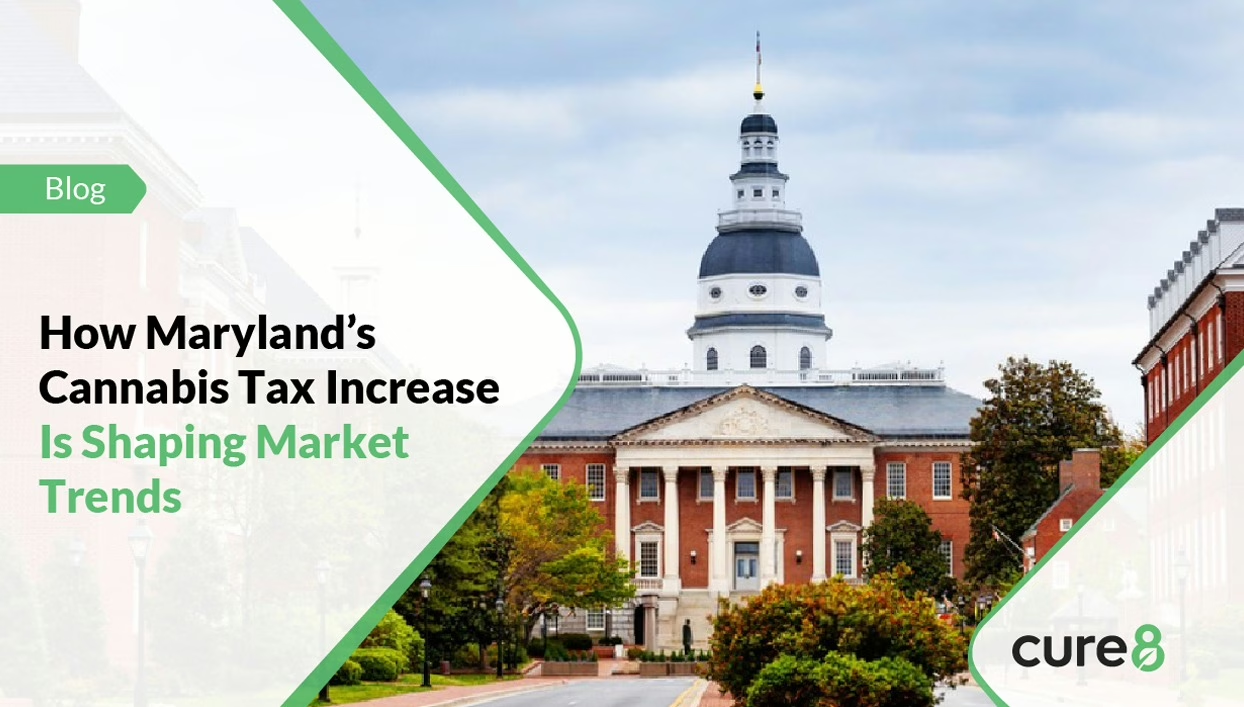
The Maryland cannabis market has stepped into its current stage, and with that step comes changes in regulatory and tax policies, including the Maryland cannabis tax 2026 adjustment, that are defining the new market standard. Since the opening of adult use cannabis sales, the state has seen fast paced expansion, a surge of fresh entrants, and strong signals of the Maryland marijuana industry growth. The state’s responses and adjustments to taxation are creating ripples into dollar pricing, buying patterns, adherence strategies, and future investments.
Imagining the post-tax policy cannabis market is more complex than the number itself. Revenue is just one part of the story. Tax policy impacts commercial competitiveness, consumer spending capacity, medical vs recreational consumption, and locally licensed operator viability and longevity. In that regard, Maryland’s legislated tax hike, now widely discussed as part of the Maryland cannabis tax 2026 shift, is more than a 3% change. It is likely a pivotal turning point in the evolution of the Maryland cannabis economy. To forecast the future of Maryland’s existing scene and understand evolving Maryland cannabis licensing trends, we need to explore what changed, why it is significant, and how operators can navigate it successfully.
Tax changes don’t just have an instant effect on prices. They also play a role in how much investors are willing to invest, how long a business takes to grow, and ultimately how much a company is worth over time. As tax expenses increase, funds can become scarcer. Cannabis companies with multiple locations are pulling back on expansion plans while smaller dispensaries need to be even more cautious with their cash. Maryland’s tax hike is doing more than just changing your shopping list. It’s impacting the long-term outlook for this market.
What Is Maryland’s New Cannabis Tax and Why Does It Matter?
On July 2025, adult use cannabis sales tax in Maryland saw an increase of 33%, jumping from 9% to 12%. According to the Cannabis Business Times, state leadership is said to have agreed to the higher tax rate as part of a package aimed at boosting government income streams.
Translating this percentage change into actual dollar terms using available Maryland cannabis sales data can be difficult, but it can also be misleading. On a per-transaction basis, the change in the percentage may look small.
How the New Revenue Is Allocated
The Maryland Office of the Comptroller had collected more than $26 million in cannabis sales tax revenue between July and September 2005.
Revenue is allocated toward:
| Allocation | Purpose |
| General Fund | State budget stabilization |
| Cannabis Administration | Regulatory oversight |
| Community Reinvestment & Repair Fund | Social equity initiatives |
| Public Health Fund | Education & health programs |
| Business Assistance Fund | Support for small and minority-owned cannabis businesses |
This regulated distribution may be Maryland’s attempt to implement a balancing act between economic progress and neighborhood revitalization strategies, but at the same time, burdens retailers trying to survive and thrive in a market environment with fierce price competition.
Here’s the crux for operators. In one respect, enhanced regulatory funding and social equity investment can confer robustness and long-term credibility on the legal market. Conversely, businesses will only be able to support that ecosystem through the imposition of additional taxes on the end consumer. If something costs too much, people will revert to the old ways. If something is affordable, the higher the likelihood of leakage back to the black market.
How Are Dispensary Prices and Consumer Demand Responding?
As taxes increase, retail prices tend to increase as well, shaping cannabis pricing trends Maryland businesses are now observing across the state.
A simple example illustrates the difference:
- A $50 purchase at 9% tax = $4.50 in tax
- The same purchase at 12% tax = $6.00 in tax
On a one-time purchase, that difference of $1.50 might be insignificant but for constant everyday consumers, this slowly adds up, illustrating the cannabis tax impact on consumers that Maryland regulators and businesses are closely watching.
Behavioral economics has identified that consumers notice dramatic conscious price increases more than small operational shifts during the transaction. Consequently, the sales tax is more likely to be ensconced in the consumer’s mental receipt, and affect buying patterns over time impacting basket size, visit frequency and substitution, primarily for infrequent shoppers, and less loyal customers.
Several early market reactions are emerging:
Increased Price Sensitivity
Consumers pay more attention to total checkout price, especially casual adult use consumers, who are not medically registered.
Shift Toward Medical Registration
Those enrolled in medical cannabis programs do not have to pay the same adult-use sales tax as the recreational consumer, giving registered patients a leg up in price. Some recreational consumers are accounting for this added cost and re-evaluating medical programs.
Competitive Pressure from Untaxed Alternatives
Local coverage has brought attention to a wider than ever availability of intoxicating hemp products that are administered under a different regulatory structure and may have a different tax burden.
These consumer changes are starting to display more widespread market patterns that are influencing Maryland dispensary revenue trends, so this is a good time to ask if these higher taxes are ultimately boosting or restricting Maryland’s cannabis market growth.
Is the Cannabis Tax Increase Helping or Hurting Maryland’s Market Growth?
It really depends on how you look at it.
Benefits for the State and Communities
- Enhancement of the community reinvestment program
- Reliable sources of revenue, which can support the regulatory framework
- Dedicated public health funding
- Assistance programs available for emerging cannabis entrepreneurs
From a fiscal perspective, the tax increases Maryland’s capacity to support its cannabis regulatory ecosystem.
Challenges for Licensed Operators
However, for dispensaries and vertically integrated operators, higher taxes introduce measurable friction:
- Lower price competitiveness against informal markets
- Strain on margins if some retailers should bear some of the hike
- Greater need for operational efficiency
- Potential slowdown in discretionary spending
Furthermore, operators need to think about the net impact of other fixed costs like security infrastructure, compliance labor cost, licensing fees and insurance, all of which are key components of rising Maryland dispensary operating costs. A surge in the retail price combined with steady or increased operational costs can very quickly leave you with fewer and thinner profit margins unless you have solid data visibility and control of the operation. This is where infrastructure takes on the added dimension of being strategic rather than optional.
Even a small change can have an impact on growth in an evolving market. Cannabis has a price sensitive industry, and competitive balance is fragile. This is true particularly in a state that will still be establishing its long-term market.
How Does Maryland’s Cannabis Tax Compare to Other States?
Cannabis taxation in the United States is widely varied. Maryland’s 12% retail sales tax has placed it in the middle of tax rate comparison.
According to Tax Foundation data:
| State | Tax Structure | Effective Rate |
| Maryland | Flat retail sales tax | 12% |
| Colorado | Retail + excise | ~15% |
| California | 15% excise + state/local taxes | 20%+ |
| Connecticut | THC-based excise | Variable |
Maryland’s flat-rate system is administratively easier to administer, and easier to understand, than the THC-based approach, but will still have a direct impact on price competitiveness. Flat-rate taxation is an administratively simple way to administer, avoiding the complexity of delineating different product types, or pricing variations by potency, but it does not weigh the relative costs of expensive and cheap product types on consumers. Regulators may elect to tax lower-priced products more leniently, or to more heavily tax higher priced products, or both, with a THC-based excise or tiered structure.
As the Maryland market evolves, policymakers should determine to what degree structural adjustment is warranted, balancing revenues and consumer costs. Increasingly, there will be an interstate comparability issue, especially for border residents, that should factor into tax structure considerations.
What Market Trends Are Emerging in Response to the Tax Change?
Policy changes seldom work on their own. They have a chain reaction effect on all aspects of operation, customer psyches, and business strategy.
Trend 1: Greater Emphasis on Value-Based Purchasing
Consumers are gravitating toward:
- Promotions and loyalty programs
- Bulk purchasing
- Discount product tiers
- Bundled deals
To cope with the current demand, the retailers are also shuffling around inventory.
Trend 2: Strategic Product Mix Optimization
Operators are focusing on:
- Higher-margin SKUs
- Private-label or house brands
- Product categories relatively immune to pricing comparisons
Trend 3: Enhanced Operational Efficiency
As margins tighten, dispensaries are seeking efficiencies in:
- Inventory management
- Labor scheduling
- Compliance reporting
- IT infrastructure
This transition to operational accuracy will inevitably result in a greater dependency on these specialized cannabis technology vendors.
Operators now understand that operational effectiveness is not just ‘cutting waste’ but that it’s about creating visibility into sales, tax reporting, inventory turnover, and records of compliance that can be objectively measured. Those that have the visual clarity with look through data will have the ability to respond more quickly to pricing pressure, improve product selection management, and safeguard margins more effectively than reactive operators.
What Should Maryland Cannabis Operators Do Next?
Tax hikes are not easily rolled back, so its adaptation that pays in the long run.
Step 1: Conduct Margin Impact Analysis
Model how the 3% increase affects:
- Gross margin
- Net margin
- Average transaction size
- Customer retention
Data driven insights enable avoiding reactive pricing decisions.
Step 2: Strengthen Compliance Infrastructure
Higher tax revenues often coincide with increased regulatory oversight and stricter expectations around cannabis compliance that Maryland businesses must follow. Operators should ensure:
- Accurate tax reporting systems
- Automated POS tax calculations
- Secure financial record storage
- Audit-ready documentation
Our previous blog with helpful information on Licensing to Reporting helps Understand Cannabis Compliance in Maryland while also discussing the benefits of forward-leaning compliance systems in an increasingly stringent regulatory environment.
Step 3: Optimize Technology Stack
Advanced POS and IT systems allow operators to:
- Automate tax logic
- Track real-time sales performance
- Generate compliance reports instantly
- Identify profitable product segments
Step 4: Prioritize Customer Retention
When price hikes are inevitable, aim to retain instead. With the right loyalty program, even with price hikes, businesses can make price considerations less sensitive. For email and content marketing, stay on topic by providing high quality information.
These strategies are interconnected, and technology sits at the center of making them effective.
How Can Technology and Security Support Operators Through Tax-Driven Market Shifts?
The pressure of market shares can bring out operational flaws. Cannabis operators must ensure:
- Secure data environments that meet Maryland cannabis security requirements for handling tax and transaction data
- Integrated seed-to-sale tracking
- Cybersecurity protections for financial systems
- Compliance monitoring aligned with evolving Maryland cannabis compliance requirements
- Scalable IT infrastructure supporting growth
In heavily regulated industries like cannabis, resilience is hardly achieved through removing compliance or related expenses. It happens by feeding in logic and infrastructure to channel through more and more regulatory change. The Maryland cannabis tax 2026 increase is a clear indicator of constantly shifting policies in the state’s regulated cannabis market. Those who use compliance and technology as initiatives will always beat the rest.
Cure8 is a reliable partner in Cannabis IT & Security, providing solutions for dispensaries, growers, and distributors, where compliance is fundamental. Whether it is a cannabis security consultation, complete installation or compliance monitoring, we will help you develop a security structure that works just as hard as you do.
In a higher-tax environment, resilience is built on precision — and precision requires reliable technology.
What Does the Future Hold for Maryland’s Cannabis Market?
The Maryland cannabis tax 2026 increase signals a move toward systematic maturation after a period of rapid market growth. As the market stabilizes, operators willing to invest in infrastructure, compliance and strategic planning will be best placed to succeed.
Possible future developments include:
- Amendments to tax structure proposed if growth falls below a certain level
- Continued refinement of social equity programs
- More regulatory pressure as earnings increase
- Increased focus on operational efficiency and cost control
Policy will change, but building blocks like robust systems, transparency of data and secure operating environments will be critical in either case.
Conclusion: Turning Policy Pressure into Strategic Advantage
A cannabis tax hike in Maryland Is driving pricing, behavior and business strategy Changes in the state. The Maryland cannabis tax 2026 increase has not been without costs, but it has also been a driving force for greater market professionalism and a boon to operators who establish sustainable, compliant, and technologically adept operations. Instead of seeing the 12% tax as an obstacle, consider it a springboard for operators, inspiring them to deliver smarter levers of pricing, compliance and IT systems.
We at Cure8 have been the go-to security and IT consulting partner for dozens of dispensaries, growers, and distributors, providing everything from consultation and design to installation and ongoing monitoring.
If you’re looking to build a thriving, secure, and compliant business in Maryland’s expanding cannabis markets, we are your solution for maintaining a competitive advantage with compliance and point-of-sale optimizations, implementing hi-tech surveillance and access control, and designing, installing, and supporting a fully integrated IT infrastructure.