



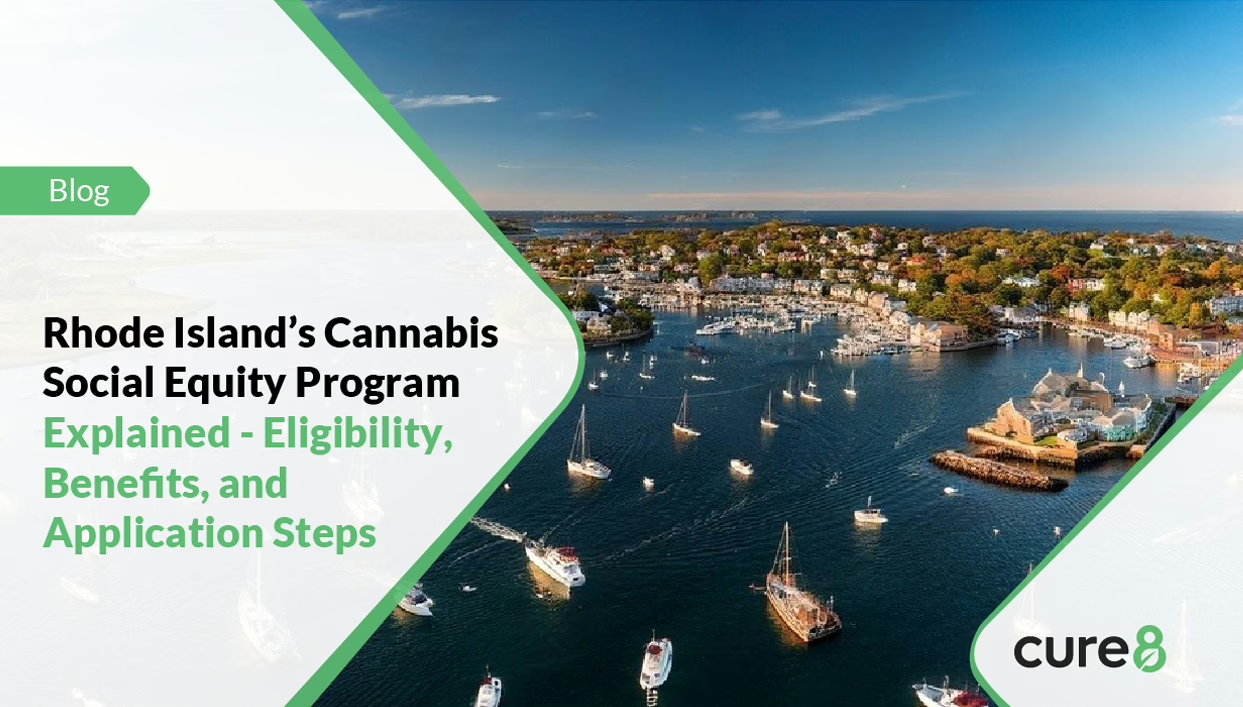
With Rhode Island opening an application window for 24 new adult-use cannabis dispensary licenses, the state has built in a strong social equity component. This is part of the broader Rhode Island social equity program aimed at fair participation in the cannabis industry. For entrepreneurs, community advocates, and prospective licensees, understanding Rhode Island cannabis social equity is essential.
In this article, we’ll walk through:
- The background and purpose of Rhode Island’s Social Equity Program
- Eligibility criteria and definitions
- The tangible benefits of social equity status
- Step-by-step guide to the application process
- Risks, challenges, and strategic tips
- How Cure8 can help with security, compliance, and technical support
Background & Purpose of Rhode Island’s Social Equity Program
When Rhode Island enacted its adult-use legalization and regulation law (through the Rhode Island Cannabis Act of 2022), lawmakers specifically enumerated a Social Equity Assistance Program and Fund to compensate for decades of uneven enforcement in communities of color. Together, these form the foundation of the Rhode Island cannabis social equity framework.
It aims to make it possible for individuals and communities adversely affected by historic cannabis prohibition to secure licenses, capital, technical support, and assistance so that the rewards of legalization are more fairly shared.
This legislative framework is central to the Rhode Island social equity program and its effort to balance opportunity. Of the state’s 24 new dispensary licenses in the initial round of adult-use retail licensing, 6 will be held for social equity-qualified applicants, and 6 will be held for worker-owned cooperatives. The other 12 are “open” licenses, available to any qualified applicant who meets minimum requirements. This allocation is a testament to Rhode Island’s dedication to social equality in its young cannabis retail industry.
A 2025 Cannabis Control Commission presentation points out that in every one of the six geographic zones of the state, one social equity license will be granted, along with an “open” license and a cooperative license.
Since the available licenses are scarce, and competition is likely to be intense, social equity status confers significant benefits, and not only symbolic, but concrete. However, to enjoy that benefit, applicants will have to undergo a stringent and intricate qualification and certification process.
Eligibility Criteria: Who Qualifies
To be a Rhode Island social equity applicant, one must meet statutory and regulatory requirements established in the Cannabis Act and associated CCC rules. The Rhode Island cannabis ownership requirements play a key role in determining who qualifies for these licenses.
Some of the important elements are as follows:
Core definitions:
- Applicant: A resident of Rhode Island (or business with a primary location within the state) applying for a cannabis certificate or license, where 51 % or more of equity is in Rhode Island residents’ hands, and that complies with other requirements.
- Social equity applicant: A candidate who also meets one or more of the “disproportionate impact” factors (defined below) and is certified by the Commission.
Disproportionate Impact and Other Criteria
To qualify under the Rhode Island social equity program, applicants must demonstrate more than residency. They must also prove disproportionate impact, community ties, and ownership alignment. A candidate must demonstrate that those involved have been impacted disproportionately by cannabis prohibition or enforcement or lived in a Disproportionately Impacted Area (DIA) for 5 of the past 10 years.
According to the RI Current, DIA classification is established through census tract statistics, based on criteria like federal poverty level, unemployment level, percentage of students receiving free lunch, and past marijuana arrest rates.
The following are some of the common paths to qualification:
- A conviction of a nonviolent marijuana offense (or immediate family member thereof).
- Living in a DIA (five of last ten years).
- Demonstrated economic empowerment in a DIA (e.g. through business, employment, or volunteering).
It’s worth noting that simply residing in a DIA does not guarantee certification. Applicants must also satisfy all applicable criteria and present documentation.
Further eligibility rules include:
- Income limits and household income documentation: Regulation requires the applicant’s household adjusted gross income to reflect all sources (wages, tips, rentals, etc.).
- Ownership and control: The persons who qualify for the disproportionate impact requirement must have at least 51% equity and decision-making control of the licensee entity. These Rhode Island cannabis ownership requirements ensure that equity applicants truly benefit, rather than outside investors.
- No conflicting applications: An individual cannot be a key person or interest holder in more than one social equity application.
- If the social equity status is denied to the applicant, he/she is provided with a 10-day cure period in which he/she can provide further evidence or choose to pay fees as a non-equity applicant.
In brief, eligibility is not just location- or history-based, but also ownership structure, documentation, and integrity of application.
Key Benefits of Social Equity Status
Why seek Rhode Island social equity program certification? The incentives are genuine and can meaningfully decrease both cost and operational pressures.
Fee waivers and discounts
- The application fee (typically $7,500) is waived for social equity licensees in the first round.
- The annual license fee in year one for social equity licensees is zero, increasing incrementally through the following years to $30,000 by year five.
- Under law, the Commission can waive up to 100% of nonrefundable license application and acquisition fees for social equity applicants.
For open or cooperative licenses, the application fee is $7,500 and annual license fee is $30,000.
The direct cost savings can therefore be tens of thousands of dollars in the initial years.
Access to Social Equity Assistance Fund
The Social Equity Assistance Program and Fund of Rhode Island was created to make grants, technical assistance, business development services, and training available to certified social equity applicants. Together, these initiatives reflect the heart of the Rhode Island cannabis social equity mission: to reinvest in communities affected by past prohibition.
Though disbursements are subject to appropriation and regulation, the intention is to assist in paying for startup expenses (not including inventory or property), compliance training, personnel, and other operational assistance.
These incentives can equalize the playing field for applicants who lack decades of capital or experience in the cannabis industry.
Preferential selection mechanics
All eligible applicants in the social equity pool are placed into a lottery for each zone (as opposed to first-come-first-serve or highest-bid). This diminishes opportunities for insiders or deep-pocket players.
Since there are only a limited number of social equity slots available (one per area), the lottery method is meant to ensure fairness and limit favoritism.
Branding, public goodwill, and mission alignment
Being a socially recognized equity licensee can improve your reputation in your local community, policy advocates, and local governments. Operators with social equity credentials may be preferred or favored by many municipalities.
It assists in showing you’re not merely entering cannabis for financial gain, but to further justice, equity, and fair economic empowerment.
Application Steps: From Interest to License
The following is a step-by-step guide to how an applicant can go about applying for a cannabis social equity license in Rhode Island. Be sure to check for any updates from the CCC, as procedures may change.
1. Fill out the Interest Form to get into the Social Equity Applicant Status Certification (SEASC) portal: The CCC has created an Interest Form (through its website) from August 28 to September 24 (for 2025) for social equity certification applicants. Upon submitting the form, the applicant is granted access to the SEASC Portal and guidance on follow-up steps.
2. Collect documentation and apply for certification: This documentation stage is the most complex part of the Rhode Island social equity application process, requiring detailed verification. At the SEASC portal, applicants provide detailed documentation to support their claim of social equity.
Some examples of required documents include:
- Proof of residency over time (e.g. leases, utility bills)
- Conviction records or expungement documentation
- Income statements, tax returns, household income records
- Incorporation, ownership, and control documentation of your entity
- Employment, volunteer or business records associated with DIAs
- Any municipal zoning or site control documents
- Other affidavits or sworn statements as required by Commission
The Commission examines these documents to verify compliance under regulation 560-RICR-10-10-1.11.
3. Decision of certification, cure period, or denial: After examination, the Commission can:
- Accept you as a certified social equity applicant
- Deny certification, but grant 10 days to cure or provide additional evidence
- Deny certification and turn you into open applicant (if you choose to pay fees)
If certified, your status entitles you to apply for the social equity retail license in your desired zone during the application round. Applicants who successfully pass the Rhode Island social equity application process then prepare for retail licensing.
4. Put together full dispensary license application: Armed with social equity certification, you then need to put together a strong retail license application.
Some of the main features include:
- Business plan, financials, startup budget, market analysis
- Site control/lease or property deed
- Zoning compliance and municipal approvals
- Security plan, surveillance, access control (this is where expertise in cannabis security solutions in Rhode Island becomes most important)
- Inventory controls (seed-to-sale tracking)
- Staffing, operations, training plans
- Compliance and standard operating procedures
- Impact plan/community reinvestment strategy
- Supporting documentation of social equity status
The complete application needs to be submitted to the Cannabis Licensing Portal by the designated deadline (in 2025, December 29, 2025 at 4:00 PM EST)
5. Initial screening/threshold review: CCC staff will review completeness and if minimum standards have been met. Only those who pass this threshold proceed to the lottery pool. Applications that do not meet bare minimums will be rejected.
6. Lottery selection: Eligible social equity applicants are placed in a public lottery for every zone. A social equity license in every zone is randomly distributed from the eligible pool.
7. Licensing and post-selection due diligence: Winners are required to undertake final review processes, such as local approvals, inspections, proof of readiness, security installation, compliance checks, and issuance of final license. Certain conditions and milestones must be met in the context of a 12-month development period.
If a selected applicant cannot fulfill these post-selection requirements, the license can be revoked or reassigned.
Challenges, Risks, and Strategic Tips
Though the social equity track has its benefits, candidates need to be aware of its challenges as well.
Few slots & high competition
Only six social equity slots are available in total, so it will be highly competitive. Even qualifying candidates might not get lucky. Careful differentiation, compliance stringency, and preparedness are crucial.
Financial risk of initial investment
Most application components (site control, architectural plans, consulting, security framework) need to have capital invested up front before you’ll even know if you’ll be awarded. This is why participants in the Rhode Island cannabis social equity program should plan financials carefully to stay compliant. Some have complained about the risk of spending money on zoning and real estate with a high chance of losing the lottery.
Regulatory uncertainty and changing rules
Since CCC and state regulators are still working on rules to implement social equity, some of the procedures may change. Remain vigilant for regulatory changes, particularly regarding fund disbursement, scoring, and compliance requirements.
Complexity and burden of documentation
Numerous years of residency, income, conviction history, employment, and control interest must be precisely documented by applicants. A small discrepancy or missing documents can jeopardize the whole certification process.
Equity vs competitive strength
While social equity offers special benefits, your application overall must be competitive in business planning, operations, security, compliance, and community relations. A poor plan can still lose in the threshold review.
Geographic areas can complicate equity goals
The state needs to distribute social equity licenses over six zones, and few municipalities currently qualify as DIA (Central Falls, Providence, Woonsocket, some Pawtucket and Newport tracts). This implies that certain zones might not have as many local or eligible applicants.
Strategic Recommendations & Best Practices
To increase your chances:
- Start early: Don’t wait until the application window. Begin getting documents in order, zoning prospecting, and community engagement right now.
- Work with local partners: Collaborate with community-based organizations and advocacy groups within areas disproportionately affected to enhance your social mission.
- Tap technical assistance: Utilize CCC workshops, public presentations, and commission resources accessible on the Social Equity Assistance page.
- Plan capital conservatively: Avoid up-front sunk costs where possible, until certified or selected.
- Empower your compliance and operations plan: Even in a lottery, you will need to pass the threshold review. Emphasize your security plan, staffing, community reinvestment, and operational maturity.
- Document carefully: Maintain extensive logs, affidavits, and source records to support your claims.
- Use experienced counsel and consultants: Particularly for regulatory, security, and technical issues, including cannabis security solutions in Rhode Island. Partnering with professionals familiar with Rhode Island cannabis ownership requirements can prevent costly missteps. Our tech compliance checklist for opening a cannabis dispensary can also be a useful resource in this regard.
- Stay up to date on rule changes: Keep an eye on the CCC’s meeting minutes, public workshops, and regulatory news.
Why This Matters, and Why Cure8 Can Help
Rhode Island’s social equity program is not merely a regulatory checkbox, but a tool for righting decades of cannabis enforcement disparities, fostering diverse entrepreneurship, and investing in underinvested communities. However, the route is complicated and competitive.
Cure8 is a trusted cannabis IT and security partner with experience in assisting dispensaries, cultivators, and distributors in remaining secure and compliant. Whether it’s cannabis security consulting or complete installations and compliance tracking, we enable you to create a security system that keeps up with you. In Rhode Island, our services can complement your social equity application strategy seamlessly, making your security and compliance story an asset, and not a vulnerability.
If you’re considering applying for a cannabis social equity license in Rhode Island, or want help fortifying your application, feel free to contact us to schedule a meeting. Our team can lend their expertise regarding:
- Security and surveillance design tailored to your requirements
- Compliance documentation, SOPs, and audits
- Network and IT infrastructure for cannabis operations
- Risk assessments and regulatory gap analysis
- Technical support for application drafting
We’ve also covered related topics in our other Rhode Island-centered blogs, relating to what potential cannabis business owners should know and key insights into the emerging Rhode Island cannabis market, to deepen your understanding of the competitive landscape.
Final Thoughts
Rhode Island’s social equity program offers a powerful route for historically impacted individuals and communities to gain access to cannabis business opportunities. But eligibility, documentation, and execution are essential. If you’re serious about competing for one of those six reserved licenses, start preparing now, invest in compliance and security infrastructure, and consider expert support to strengthen every aspect of your application.
At Cure8, we are prepared to help you develop a strong, compliant, and technically solid application that best prepares your business for success in Rhode Island’s emerging cannabis industry. If you’re pursuing a Rhode Island cannabis social equity license, Cure8 can help you build the right foundation for success.